
Blog
Handleless Kitchens in India: G-Profile, J-Profile and Push-to-Open Compared for Indian Cooking
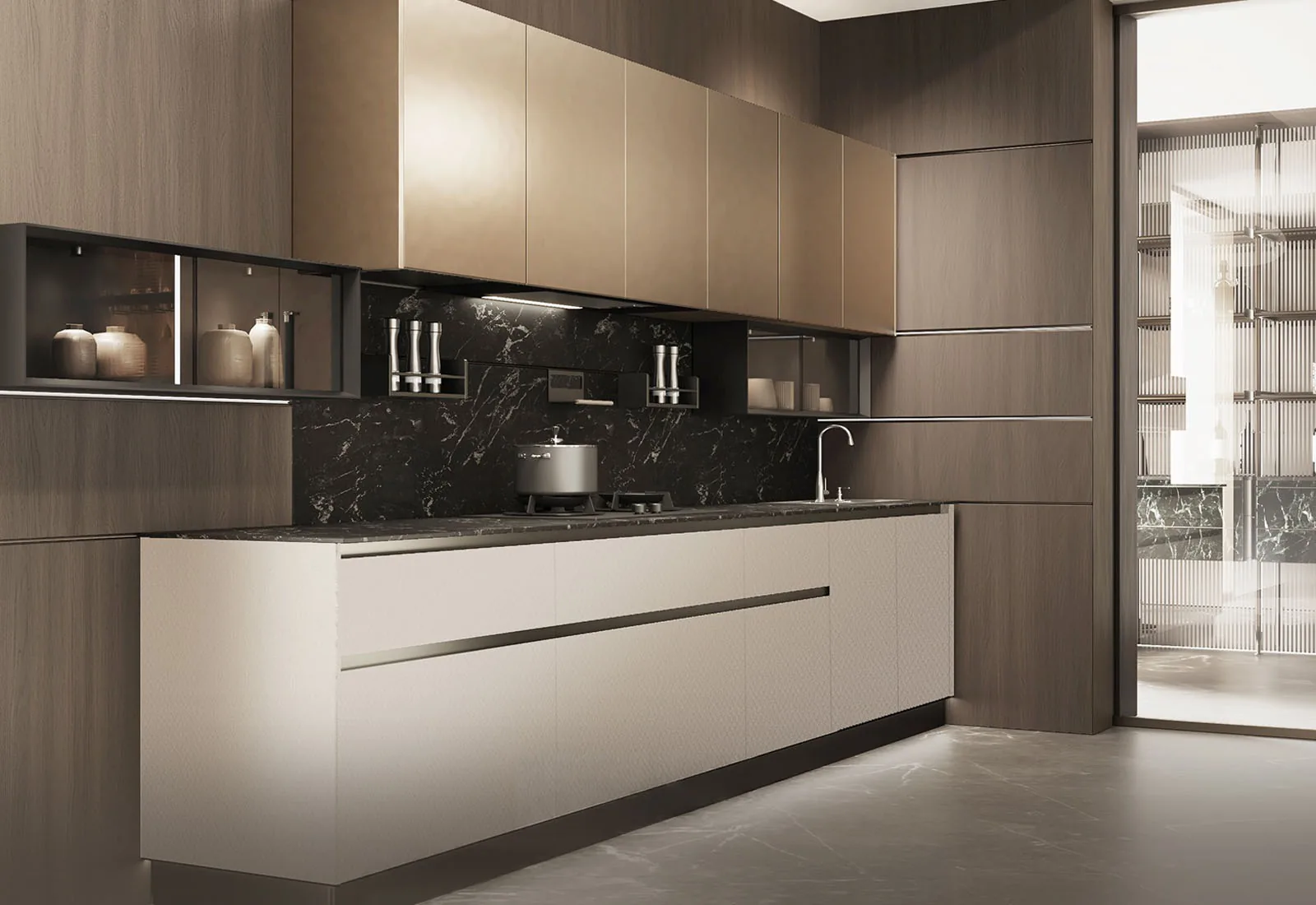
Handleless is the defining look of contemporary European kitchens: clean horizontal lines, no protruding hardware and a calm, uninterrupted surface. It is also one of the most common questions we hear in Delhi: will this survive real Indian cooking, with oil, masala, wet hands and daily heavy use? The honest answer is yes, if the system is chosen for how you cook. This guide explains the options, the trade-offs and the care routine.
What is a handleless kitchen?
A handleless kitchen has no external handles. Instead of a knob or a bar, the doors and drawers open through a built-in grip or a mechanism. The three most common systems are:
- G-profile. A continuous groove or channel along the edge of the door, drawer or unit. You slide your fingers into the groove to pull it open.
- J-profile. A profile with a lip or hook along the edge, shaped like the letter J. You catch the lip with your fingertips.
- Push-to-open. A mechanism that releases the door or drawer when you press the front. There is no grip at all.
A fourth option, a finger-pull or recessed grip cut into the panel, sits between these. The names and shapes vary a little between manufacturers, so always ask to see the actual profile in a sample.
Handle-less profiles are one of the core principles of the Italian design approach that OPPEIN's collections follow, along with restrained proportions and precise shadow gaps. You can read more in our guide to Italian kitchen design in India.
G-profile vs J-profile vs push-to-open: which is best?
| G-profile | J-profile | Push-to-open | |
|---|---|---|---|
| How you open it | Fingers into a groove | Fingers behind a lip | Press the front panel |
| Look | Clean line with a visible groove | Clean line with a slim lip | Completely flat front |
| Daily comfort | Easy grip, even with a load | Easy grip | Needs a firm, correct press |
| Cleaning | Wipe the groove regularly | Wipe the lip and underside | Easiest to wipe, but fingerprints show |
| Best for | Base units, drawers, heavy doors | Wall units and base units | Tall units, wall units, low-use areas |
| Watch out for | Oil and dust collecting in the channel | Edge needs a protective wipe | Mechanism quality and alignment |
In short: G-profile and J-profile are the safer choices for areas you use all day. Push-to-open suits places where you want a perfectly flat look and where you open doors less often.
Are handleless kitchens practical for Indian cooking?
It depends on four things.
1. Oil and masala. Indian cooking releases oil vapour that settles on surfaces. Grooves and lips can collect that film and dust, so you need to wipe them as part of your routine. A smooth handle is easier to wipe around, but it also traps grease behind itself. Neither option is maintenance-free.
2. Wet or oily hands. A groove or lip gives you a grip even when your hands are slippery. A flat push-to-open front can be harder to press with oily fingers and can smudge.
3. Heavy use. Pots, pans and heavy drawers are used many times a day. A grip that lets you pull with your whole hand is more comfortable than a light press mechanism.
4. Who uses the kitchen. Children, elderly family members and anyone with limited grip strength may prefer a more generous grip. Consider keeping a few traditional handles or a longer profile in the most-used areas.
What hardware does a handleless kitchen need?
Handleless does not mean hardware-free. It means the hardware moves inside the cabinet, and that makes quality more important.
- For G and J profiles: strong hinges and drawer systems, because you pull on the edge and the load is higher at the grip.
- For push-to-open: a quality push-latch or mechanism that opens smoothly and consistently, and that works with soft-close if you want it. Ask which mechanism is used and whether the combination is supported by the hardware brand.
- For all systems: precise alignment, because a handleless kitchen shows every uneven gap.
OPPEIN kitchens use Blum, Hettich and REHAU hardware. To understand why the parts you do not see decide how a kitchen feels in year five, read the hardware you don't see and our comparison of Blum vs Hettich kitchen hardware.
How do I clean a handleless kitchen?
A short routine keeps grooves and lips from building up grime.
| When | What to do |
|---|---|
| Daily | Wipe the hob area and any fronts near it with a damp cloth |
| Weekly | Run a soft microfibre cloth along every groove or lip, then wipe the full front and dry |
| Monthly | Use a soft brush or a cotton swab for tight corners and the underside of profiles |
| Seasonally | Check that doors and drawers still align and that mechanisms release cleanly |
Avoid abrasive pads and harsh chemicals, especially on lacquer and gloss finishes. Choose a finish that suits the way you clean. Our guide to kitchen finishes compared explains how each finish behaves, and the materials page shows the palette we work with.
Are handleless kitchens more expensive?
Usually yes, because profiles and mechanisms add components, and because the panels and fit need to be more precise. The exact difference depends on the system and the layout, so ask for an itemised quotation that shows the handleless component separately. A good designer will also show where you can save by using handleless fronts in the most visible areas and simpler grips in hidden or low-use ones.
Where do traditional handles still make sense?
Many of the best kitchens mix systems. Consider handles or longer grips for:
- Tall pantry or fridge units, which are heavy and need leverage
- Deep pan drawers that carry the heaviest loads
- Units used by children or elderly family members
- Rental or resale homes, where buyers may prefer familiarity
A mixed approach keeps the clean look where it matters and protects practicality where it counts.
Does handleless work in a small kitchen?
Yes, and often better than handles, because there is nothing to knock against in a tight space. In a compact kitchen, clean fronts also make the room feel calmer. See small modular kitchen design for more on making a small kitchen work, and open kitchen design in India if your kitchen is visible from the living room, where a handleless look is especially effective.
What should I ask before choosing a handleless kitchen?
- Which profile or mechanism is used, and can I see a sample?
- Which hardware brand and series is behind it?
- How are the grooves cleaned, and can I try it on a sample?
- What is the price difference compared with handles?
- Which areas would you recommend keeping with handles?
- How is alignment checked on site?
- What is the warranty on the mechanism?
A kitchen that looks effortless is the result of careful planning. Read designing a kitchen that ages well and kitchen layout planning for Indian cooking to bring layout, materials and hardware together.
Frequently asked questions
What is a handleless kitchen?
A handleless kitchen has no external handles. Doors and drawers open through a built-in grip, such as a G-profile or J-profile, or through a push-to-open mechanism.
Are handleless kitchens practical for Indian cooking?
Yes, if you choose a G-profile or J-profile for daily-use areas and keep to a regular wiping routine. Oil and dust can collect in grooves, so cleaning is part of the system.
What is the difference between G-profile and J-profile?
A G-profile is a groove along the edge that you pull with your fingers. A J-profile has a lip or hook that you catch with your fingertips. Names and shapes vary slightly by manufacturer.
Do push-to-open cabinets break easily?
Quality mechanisms from good hardware brands are built for heavy daily use, but alignment and installation matter. Ask which mechanism is used and what the warranty covers.
Are handleless kitchens more expensive?
Usually, because they need extra profiles or mechanisms and more precise fitting. Ask for an itemised quotation to see the exact difference.
How do I clean a handleless kitchen?
Wipe grooves and lips weekly with a soft microfibre cloth, use a soft brush for tight corners, and avoid abrasive pads and harsh chemicals.
See handleless kitchens in person
Visit the Experience Centre at Ground Floor, A-53, Okhla Phase 2, New Delhi 110020, Monday to Saturday, 10:30 to 19:00, or call and WhatsApp +91 84476 77346. Book a free design consultation, browse the kitchen range, learn about OPPEIN Delhi NCR and find more guides on the OPPEIN blog.